A Good Enough Podcast for our times.
Three millennial psychiatrists, military veterans, and friends break down what feels alive in America, right now, through a biopsychosocial lens.
Because sometimes America doesn’t need another hot take, it needs some time with a shrink.
We don’t need all the answers. And we will never be a Perfect Union. But we do need to be Good Enough to keep the American Dream alive and well.
Our episodes take two basic approaches. In some, we take a deep dive into an important, relevant theme from our field and apply it to what we’re seeing in our country (e.g. “narcissism”). In others, we analyze a particular issue we’re seeing in our country with a variety of our tools (e.g., how are we responding to America’s return to the Moon?).
Our conversations are designed to get you to think, help you to cope, and build your toolkit to navigate today’s America. And — we like to have quite a bit of fun along the way.
A Good Enough Toolkit

Dialectic Thinking
The concept of the dialectic refers to the power of being able to integrate two opposing ideas. It was popularized in the psychiatric world by Marsha Linnehan who developed Dialectic Behavioral Therapy. Central to this work is the validation and acceptance of current experiences while working towards change. Quite simply, its our most recurring theme in Shrinking America.

Read and Appreciate History
Understanding history helps broaden our perspectives. Anxiety and depression, broadly speaking, are states of narrowed thinking. If we can develop an appreciation for how our current troubles are either recurring, or even better than those before us, it can release us from anxious rumination.
(Link is to Sarah’s favorite long form way to consume history if you click the image.)

Acceptance and Commitment Therapy
As our lives are filled with stressors outside of our control, one relative constant is our values. But sometimes we stray from those and need help clarifying them and recalling how we can act more in accordance with them. Acceptance and Commitment Therapy tools remind us that despite our challenges and our vulnerabilities, we can always choose to live a life committed to our values.

Defense Mechanisms
Most of our episodes will mention at least one defense mechanism.
Honestly, whoever wrote it on wikipedia said it well “in psychoanalytic theory, defense mechanisms are unconscious psychological processes that protect the self from anxiety-producing thoughts and feelings related to internal conflicts and external stressors”. They have varying levels of adaptability and maturity — being aware of when they’re at play can help us to understand our own and others’ behaviors more fully, refocusing our examination on what the root cause of the anxiety is and how we might defend against it optimally.

The Good Enough…
Another concept we (clearly) cannot get enough of at Shrinking America. Don’t try to be the best — it’s a trap. Be Good Enough. And, of course, ironically, it’s better for everyone when you do. And leads to more action and productivity. Thanks for coining the term and giving us the evidence base for why it works, Dr. Winnicott.

Erikson’s Stages of Development
Every phase of our lives presents unique challenges. The Erikson psychosocial stages of development are a useful lens for understanding the key conflicts we face. While usually applied to individuals, like much of what we do in Shrinking America, these stages might better help us understand what phase of development we’re in as a country as well. And what consequences we might face if we don’t collaborate to work through the conflict.

Overview Effect
Mentioned in our teaser episode on the Artemis II launch, with a great quote from Astronaut Christina Koch about her Pale Blue Dot viewing experience, the Overview Effect is “the profound experience astronauts report when they see Earth from space”.
We know, not the most accessible tool in our toolkit but viewing pictures of space from Earth, looking up at the night sky regularly, and beholding our universe in awe can widen our perspective.
Cognitive Dissonance
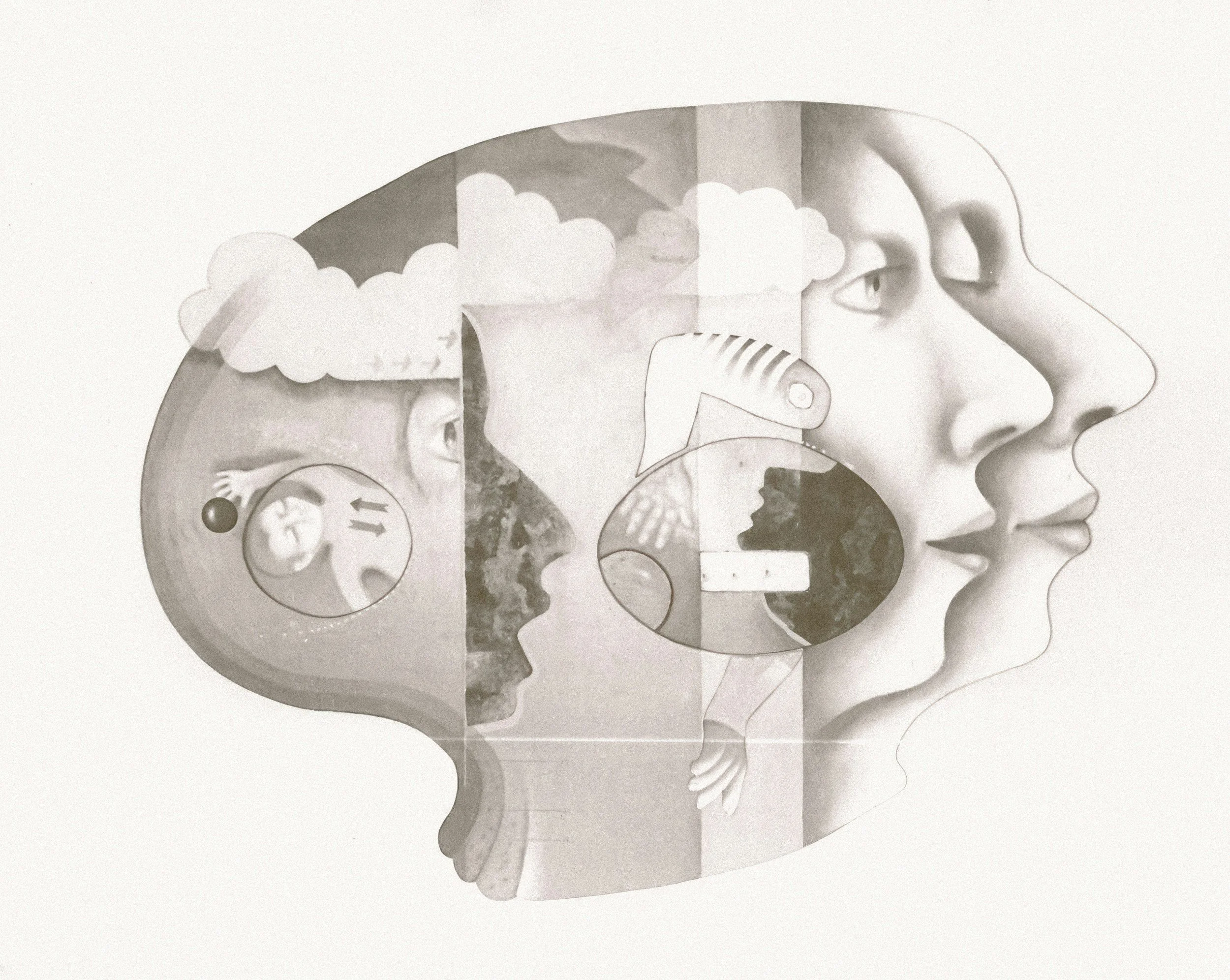
Cognitive dissonance is a psychological concept to describe the discomfort we feel when dealing with two opposing thoughts or ideas in our mind. We often try to resolve this distress by adjusting our thinking to keep our thoughts in alignment. Unfortunately this restructuring can often deepen unhelpful thoughts and behaviors. For example, it can lead to the maladaptive defense mechanism known as “splitting” where our Good Enough mother becomes suddenly not Good Enough at all because she cut our bananas the wrong way. We can often resolve the dissonance instead, by using — you guessed it — dialectical thinking.

Hawthorne Effect
Dr. Hawthorne is watching you.
The Hawthorne effect refers to how people change their behaviors when they know they’re being observed. It’s something we keep in mind in therapy as people may not be behaving in the room in the same way they do outside of it. We need to do our best to encourage and support honest conversations about our behaviors so we can actually address them. We’re thinking even more about the Hawthorne effect in regards to how people may alter their behaviors when AI is present and recording an ever-increasing amount of interactions.

Healthy Narcissism
Wait, what?
Yes, healthy narcissism exists and has probably been important in our nation’s history. You have to be a bit grandiose to bet on yourself to make your American Dream become a reality.

Internal Family Systems
Developed by Richard Schwartz, PhD, IFS is “a therapeutic model that views every human being as a system of protective and wounded inner parts guided by a core Self. It teaches that the mind is naturally multiple—and that this multiplicity is healthy—because, like members of a family, inner parts can be pushed into extreme roles but also have valuable inherent qualities. IFS helps people access their undamaged, compassionate Self, which knows how to heal, and from that inner leadership, understand and transform their parts, fostering both inner and outer connectedness”.

Humor
Our favorite adaptive defense.
Humor allows us to approach difficult truths when it might otherwise be too painful.
It alleviates anxiety and tension.
Humor connects us and builds community. It creates a shared language.
It’s one of the things that brought Sarah, Kyle and Jaremy together.

Mindfulness Practice
Yes, practice.
Mindfulness is tough in America. In 2026. So many of our patients say they “try it” and it’s too hard. Their mind is too busy. It wanders.
Yes. That’s the point. That’s why we need it. It’s exercise for your brain.
There are countless ways to practice it. The one we took to, starting in residency, was with the teachings of Tara Brach.

The Science of Habits
We are what we repeatedly do.
Want to work on meaningful, sustained change?
Work on your habits.
Do it with the help of experts, like James Clear.

The Value of Aimlessness
Our best ideas, our inner truths, may just come when we are feeling lost.
Einstein, author of the Theory of Relativity, was “proof” of just this.
So when you’re feeling lost in the woods, lean in.
“Wasting time” might just be the only way you figure out where you need to go.

Rupture and Repair
This is one of those concepts in therapy that is so powerful, so integral to what we do, that we will keep coming back to it. And we will certainly have moments of it, amongst the three of us, wherein which we hope to model the process as best we can.
But the very nature of the process, of relationships, is messy. It’s the getting through that, wherein the relationship is strengthened.
And — in therapy, and in life, its the strength of your relationships that seems to mean the most.
Look, but don’t stare.
Cherished wisdom from RuPaul.
Put another way — what we water, grows.
We know this from the CBT triangle — our thoughts affect our moods, which affect our behaviors. What we attend to affects all of these. So, when things are difficult, be realistic, pay attention, but then focus on what you can do to generate more joy from within.

The Serenity Prayer
"God, grant me the serenity to accept the things I cannot change,
Courage to change the things I can,
And wisdom to know the difference."
It’s simple, but not easy. It takes a lifetime to learn.
Almost everything we do can be distilled down into finding out what this means for you.

Cognitive Biases
News flash: your thinking is flawed. But the more you know about the cognitive traps we all are prone to fall in from time to time, the more likely you’ll be able to side-step them.
We highlighted the Selection Bias in our American Dream episode— linked is a more comprehensive list from The Decision Lab. If you really want to examine these — we highly recommend the work of Daniel Kahneman, author of Thinking, Fast and Slow.

Cognitive Distortions
Similar to Cognitive Biases — these are unconscious ways in which your brain will mislead you. Awareness is the first step — reframing or restructuring is next.
Recognizing these is part of Cognitive Behavioral Therapy (CBT) 101. Once you learn to recognize the ways in which your brain is leading you down unhelpful paths, you can choose to change it, which will eventually result in more adaptive behaviors and positive mood states.

Touch Grass
Gen Z intuited this phrase, when they recognized they were feeling “too online”.
No surprise — nature is actually good for our brains. Even just five minutes of touching real grass (vice turf) changes people’s brain waves to more calming patterns, and they actually subjectively reported that benefit. If you’re feeling scattered or overwhelmed, find some green space, and find your center.
Who we are
Together: we are three friends who trained together in a military psychiatry residency.
As individuals:
Like Kyle’s mid-life crisis tattoo quotes, she strives to live the questions now. She’s a real sucker for the American dream, but leans hard on that adaptive coping mechanism of humor when things get a little messy. She ticks a lot of millenial mom sterotypes (wine mom, Swiftie), a husband who balances her (often untethered) enthusiasm (she’s as clear of a 7 on the enneagram as there ever was), and loves being a psychiatrist because it pays her like a doctor to be a philosopher. Most of all, she loves love, friendship, and the pursuit of a shared vision.
Sarah's core identity is an explorer. From the planet itself to the inner workings of the mind, she is constitutionally incapable of staying on the surface. Psychiatry is no exception to this ethos — nothing is off limits, and everything is grist for the mill of understanding. Shrinking America is yet another frontier — a new landscape for finding meaning in the Generativity vs. Stagnation phase of life. It's an elder millennial's way of saying we're finally old enough to know what matters, and young enough to still do something about it. We're the Oregon Trail generation, after all. Let's prep to ford this damn river.
Jaremy ‘s ongoing exploration to understand an ever-changing definition of self and purpose has led him down many paths and into the integration of many seemingly disparate parts (psychiatry babble to describe how complicated and beautiful each of us are). These parts include: spiritual being having a human experience, brother & son, guncle, featured dancer, choreographer, recording artist, high school teacher, former Mormon, Buddhist, Taoist, gay man, doctor, soldier, psychiatrist, osteopath, left midfielder, and 3rd chair violinist, to name a few. He loves psychiatry because it allows him to pull from these experiences to fulfill our archetypal role as modern-day sages and "witch doctors." He hopes his varied life experiences and insightful discussions with talented friends will support Americans in coming to a deeper understanding of their own identity and purpose."

Join us on social







Disclaimer
This podcast is separate from our respective clinical practices and employers. The views expressed are our own and those of our guests and do not represent the views of our employers. We do not endorse the views or statements of our guests.
This podcast is for educational, informational and sometimes entertainment purposes only and is not a substitute for professional medical care. Nothing in this podcast constitutes medical or mental health advice, diagnosis, or treatment, nor does it establish a doctor–patient relationship. If you are seeking personal medical or mental health care, please consult a qualified health professional. If you are in crisis, including thoughts of suicide, or harming yourself or others, please contact local emergency services or a crisis hotline like 988.